Saturday, March 15, 2014

2014 Forecast: Tigers Going All the Way This Year


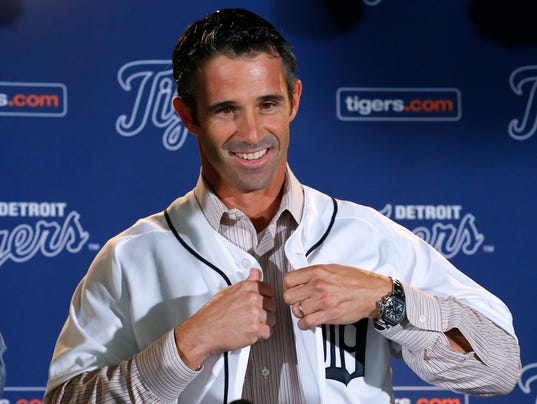
The Tigers have a new manager and a very different line-up in 2014, but expect more of the same.
(Photo credit: Paul Sancya, AP)

With opening day about two weeks away, it's time for my predicted standings for 2014.  The pre-season standings you see at places like Fan Graphs and Baseball Prospectus where almost all the teams are targeted for between 70 to 90 wins are projections rather than predictions.  Everything is regressed to the mean which results in few players having great seasons and few teams winning a lot of games.

I like to use those kinds of projections as a baseline rather than a final forecast.  Realistically, some teams will have more players having great seasons than others and those are the teams that will win 93+ games and probably make the playoffs.  The goal here is to figure out which teams.

My predicted standings are below.  There are no big surprises here.  I actually arrived at the same ten playoff teams as FanGraphs which is coincidental as I used the Baseball Prospectus projections as my base.  If I was going to pick a dark horse, it might be the Minnesota Twins who have a lot of interesting young talent.  I don't think they are ready to move up though. My National League candidate would be the San Diego Padres.

Most importantly, I'm picking the Tigers to easily win the American League Central with 93 wins.  That is the same number of wins as last year.  Don't they have less talent this year though with the trades of Prince Fielder and Doug Fister?  Yes, but their run differential last year suggests that they should have won 98 games.  They won five less games than they should have due to losing a lot of close games which I think was mostly random.  Thus, they should make up for reduced talent by having better situational performance.

Finally, since the playoffs are largely a crapshoot, there is no reason to not pick the Tigers to win the World Series.  So, that is my forecast: Tigers win the World Series.

Predicted MLB Standings 2014

AL East
W
L
PCT
Tampa Bay*
93
69
.574
Boston#
86
76
.531
New York
81
81
.500
Toronto
79
83
.488
Baltimore
75
87
.463


AL Central
W
L
PCT
Detroit*
93
69
.574
Cleveland
81
81
.500
Kansas City
78
84
.481
Minnesota
71
91
.438
Chicago
70
92
.432


AL West
W
L
PCT
Los Angeles*
95
67
.586
Oakland#
87
75
.537
Texas
83
79
.512
Seattle
79
83
.488
Houston
62
100
.383


NL East
W
L
PCT
Washington*
96
66
.593
Atlanta#
89
73
.549
New York
74
88
.457
Philadelphia
73
89
.451
Miami
65
97
.401


NL Central
W
L
PCT
St. Louis*
93
69
.574
Pittsburgh#
86
76
.531
Cincinnati
84
78
.519
Milwaukee
74
88
.457
Chicago
68
94
.420


NL West
W
L
PCT
Los Angeles*
99
63
.611
San Francisco
84
78
.519
Arizona
82
80
.506
San Diego
78
84
.481
Colorado
72
90
.444

*Division winner
#Wild card

Playoffs

Wild Card Games
Oakland over Boston
Pittsburgh over Atlanta

Divisional Series
Oakland over Los Angeles (AL)
Detroit over Tampa Bay
Los Angeles (NL) over Pittsburgh
St. Louis over Washington

Championship Series
Detroit over Oakland
St. Louis over Los Angeles (NL)

World Series
Detroit over St. Louis

Saturday, March 08, 2014

Pitch Framing Measurement Evolves and Avila Still Looks Good

 Alex Avila used his pitch framing skill to get more strikes in 2013.
(Photo credit: HardballTalk)

One of the most difficult things to measure in baseball is catcher defense.  In earlier posts, I have attempted to quantify this facet of the game based on how well catchers stop the running game, block pitches and avoid errors.  Those items only account for a portion of a catcher's responsibility though and say nothing about game calling or understanding of pitcher abilities and tendencies.

Another part of catcher defense that has not been measured until recent years is pitch framing or receiving.  You have probably heard broadcast analysts such as Tim McCarver talk about how catchers can get umpires to call more strikes by the way they receive the ball.  You may have scoffed at the notion that a catcher could consistently influence major league umpires to call more strikes.  Sure, umpires make mistakes but not because of the way a catcher receives the ball, Right? Actually, research suggests that catcher receiving may indeed be an important skill with more value that one might think.

Former Baseball Prospectus researcher and current Astro statistician Mike Fast tried to quantify the value of pitch framing by using Pitch f/x to determine where strikes were typically called by umpires.  He figured out which pitchers were getting more or less strikes than they should given the location of pitches.  This allowed him to isolate the effect of individual catchers on balls and strikes.  He found big differences between the best and worst catchers in the league.  Moreover, he determined that is seemed to be a skill that was consistent from year to year.

Fast determined that, from 2007-2011, part-time catcher Jose Molina got 551 more called strikes than you would expect for an average catcher.  According to former Baseball Prospectus writer and and current Rays statistician Dan Turkenkopf, turning a ball into a strike is worth about .133 runs on average.  So, Molina saved his teams an estimated 73 runs or 35 runs per 120 games with his pitch receiving skill.

How substantial is 35 runs per 120 games? That's about how many runs Blue Jays slugger Edwin Encarnacion produced with his bat last year which was a lot.  On the flip side, Fast estimated that Ryan Doumit cost the Pirates 26 runs per 120 games on balls/strikes during the same period.

One-time Baseball Prospectus analyst and current Cleveland Indians statistician Max Marchi did further work on pitch receiving making adjustments for umpire, ballpark, batter, ball-strike count, pitch location and type.  Marchi estimated that Molina saved his teams 111 runs from 2008 through early 2013, a number that caught the attention of Rays manager Joe Maddon.  Marchi also confirmed that Doumit was awful on balls/strikes.

A visual difference between Molina and Doumit can be seen in a Grantland article by Ben Lindbergh.  If you watch carefully, you'll see that there is very little movement when Molina catches a ball.  His body is still and the ball falls quietly into his mitt.  On the other hand, Doumit shows a lot more motion jerking his head and lunging at the ball as if he is reaching to pull it into the strike zone.  Lindbergh notes that this happens consistently on their pitches which could be what is influencing umpires.

The most recent work comes from Harry Pavladis and Dan Brooks at Baseball Prospectus.  They have developed new method called the Regressed Probabilistic Model (RPM) where they calculate combined probability that each pitch will be called a strike, determine the associated run value of getting a strike called on that pitch and sum over opportunities to estimate runs saved by pitch framing.

They make adjustments for ball and strike counts, pitch type, batter/pitcher handedness and pitcher differences among other things.  The best part may be that Baseball Prospectus has published the results for all catchers, something I've been hoping hoping they would do for a long time.  Their results were consistent with past studies giving further support to the notion that pitch framing is a real skill with a large impact.  According to this method, Brian McCann (127) and Jose Molina (116) have saved their teams more runs than any other catcher since 2008.  Conversely, Ryan Doumit (-124) and Gerald Laird(-83) cost their teams the most runs.

Last year, Tigers backstop Alex Avila had 5,460 opportunities to frame pitches and was able to get 72 extra strikes compared to an average catcher.  This was worth about 9 runs or one win over the course of the season which put him in the top third of major league starting catchers.  Avila has been consistently above average since 2011 saving the Tigers an estimated 17 runs during that time. 

Avila is not in the same class as catchers like Molina (24 runs saved in 2013) and Jonathan Lucroy (22), but he does seem to have a knack framing pitches and it helps the Tigers staff. It's something to watch as the 2014 season unfolds.

Saturday, March 01, 2014

The Ten Most Indispensable Tigers

The Tigers infield defense will take a big hit if shortstop Jose Iglesias goes on the disabled list.
(Photo credit: Julian Gonzalez, Detroit Free Press)

By virtually all accounts, the Tigers are heavy favorites to win the American League Central Division in 2014. Advanced projection systems rate them as anywhere from six wins (ClayDavenport.com) to nine wins (BaseballProspectus.com) better than the runner-up Indians with the Royals a close third.  The Tigers superior talent gives them a cushion against under-achieving players and injuries, but many things can go wrong in a long season.

Even the best teams can only sustain so much misfortune and every year the grand plans of some pre-season favorite is derailed by unforeseen circumstances.  The hardest thing for analysts or anyone else to predict is injuries and the loss of key players for extended periods can dramatically change the course of a team's season.

The reason why injuries to starting players hit teams so hard is that most clubs do not have adequate alternatives at most positions and the 2014 Tigers are no exception.  The only bench players one might expect to perform above "replacement level" might be outfielder Rajai Davis and infielder Steve Lombardozzi and both will probably receive significant playing time even if there are no major injuries.

So which Tigers regulars are the most indispensable?  The top ten are listed below. 

1. Miguel Cabrera 

The entire Tigers offense revolves around the two-time MVP and would struggle mightily without him.  Losing Cabrera for a large portion of the season would erase most of the edge the Tigers have over the Indians and Royals.  Even if they moved Victor Martinez to first in his absence, they would still need to add another bat to the order and they have no adequate internal options.  I don't think anyone wants to see Jordan Lennerton or Daniel Fields replacing Cabrera.

2. Justin Verlander

The Tigers top three starting pitchers could be 2a, 2b and 2c, but Verlander is listed first because he has the longest track record of success and durability.  Losing Verlander might not hurt quite as much as losing Cabrera because they have such a strong rotation, but it would be a huge hit.  The most obvious replacement would be left-hander Jose Alvarez, a pitcher you don't want to see getting more than a few spot starts.

3. Max Scherzer

Scherzer might not match his 2013 season, but is capable of coming close and the Tigers can't afford to lose him for an extended period of time.

4. Anibal Sanchez

See Scherzer above  

5. Austin Jackson

A lot of people seem to be down on Jackson after a somewhat disappointing 2013, but he's still an important part of the team offensively and defensively.  Despite his tremendous speed, Rajai Davis is not a great defender and is not even second on the depth chart in center.  Don Kelly is. Chances are they would go with some combination of the two if Jackson were out for a long time and that would be a big drop off.

6. Ian Kinsler

Second base might be the position where they have the best back-up option in Lombardozzi, but he doesn't come close to Kinsler who is expected to be an important cog in their offense.

7. Alex Avila

Avila battled injuries last year including concussion problems and it slowed him down at the plate and in throwing out runners.  The pitchers apparently work well with him and he was one of the top catchers at pitch framing in 2013 according to Baseball Prospectus.  If he continues to miss time with injuries this year,  it will be a blow to the Tigers.  Back-up cather Bryan Holaday is a capable defender, but won't hit much.  Another possibility is that James McCann is ready to help at the MLB level, but I wouldn't count on him playing a big role this year.  Avila is already experiencing back stiffness this spring so keep an eye on him.

8. Jose Iglesias

The Tigers are focusing more on speed and defense this year and Iglesias is an important part of the new approach.  The shortstop position is one of the Tigers weakest bench spots.  Lombardozzi has not played much shortstop, so Hernan Perez would likely take over if Iglesias has a lengthy absence.   The problem is that Perez is more of a second baseman than shortstop.  It is concerning that Iglesias is currently experiencing trouble with his shins as he had a similar problem last September.

9.  Joe Nathan

Statistical analysts often point out that bullpens are a crap shoot and that most closers are replaceable.  This is true to an extent, but I think that dependable relievers are sometimes undervalued by the modern metrics.  Nathan is the only Tigers reliever with a reliable track record of success and they need him to solidify the bullpen.  Flame thrower Bruce Rondon might be able to close if necessary, but they would still lose Nathan's innings if he were hurt.

10. Victor Martinez

As the Tigers second best hitter, Martinez might be the only thing preventing Cabrera from racking up 150 bases on balls.
      

Twitter

Blog Archive

Subscribe

My Sabermetrics Book

My Sabermetrics Book
One of Baseball America's top ten books of 2010

Other Sabermetrics Books

Stat Counter